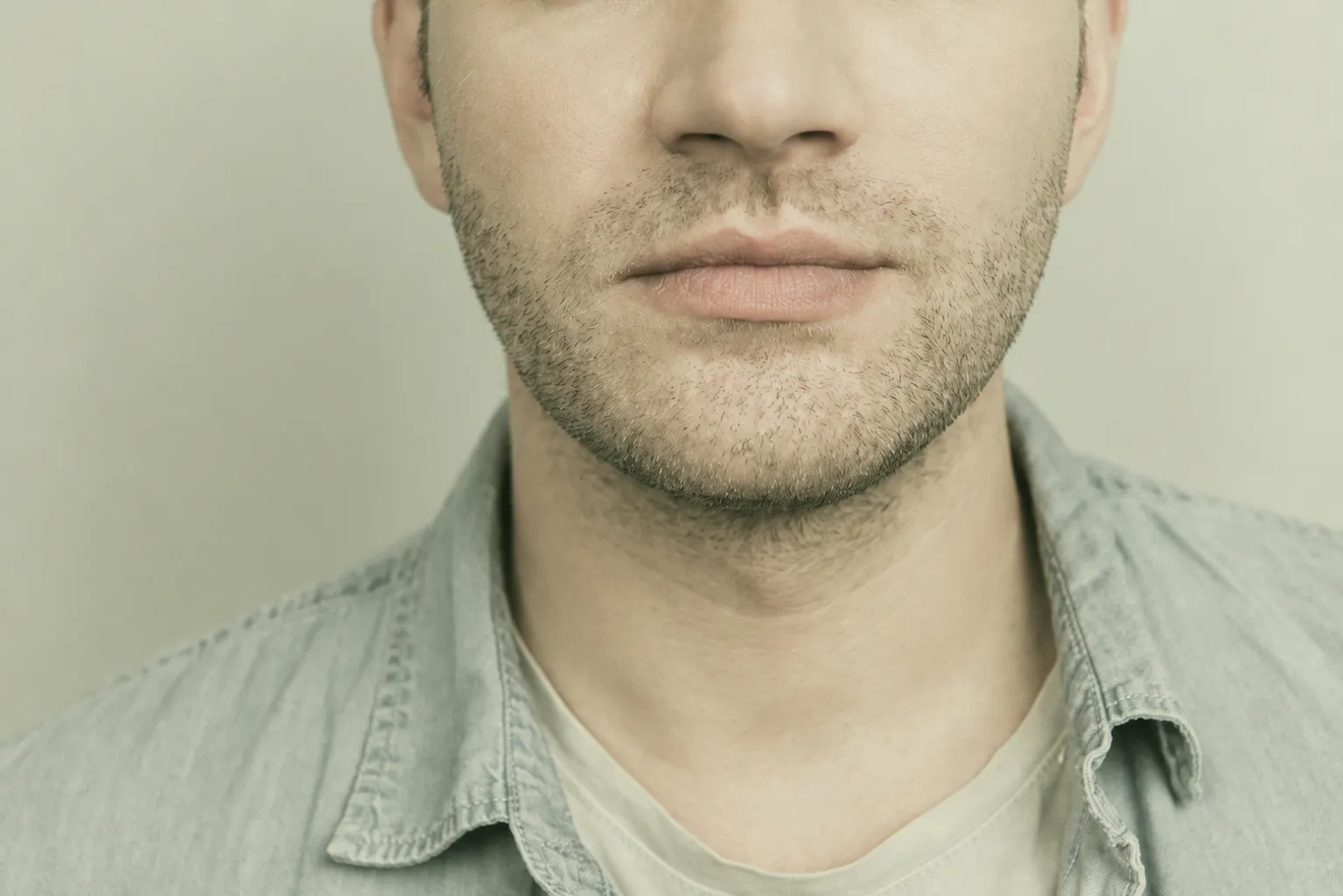

What a mustache transplant actually is
A mustache transplant uses the same follicular unit extraction principle as a beard transplant: individual grafts are taken from a donor area, almost always the back or sides of the scalp, and implanted into the upper lip area to fill patchy growth or build density and shape. The recipient area is small and highly visible, so hairline and density design matter more here per graft than in a larger session.
Symmetry and boundary planning
Because the treated area sits directly on the face and is viewed close-up and head-on more often than a beard or scalp, symmetry between the left and right sides is planned and checked more rigorously than in larger sessions, often against a centred reference line from the philtrum. The philtrum itself and the cupid’s bow are left untreated, respecting the natural gap most people have there, and caliber-matching follows the same logic as a beard transplant: grafts are selected from thicker-caliber donor areas where possible so the transplanted hair doesn’t look visibly finer than the native mustache hair it’s blending into.
Walking through a mustache transplant day, step by step
The design happens first, with a mirror and a marker. The target shape, how far it extends toward the corners of the mouth, how it should taper at the edges, is drawn directly onto your skin, checked for left-right symmetry around a centred line through the philtrum, and approved by you before anything is numbed.
Extraction is identical to a scalp or beard session, just in miniature. Under local anaesthetic, individual follicular units are removed from the donor area with the same fine punch used in standard FUE, with the technician favouring thicker-caliber grafts where available so the transplanted hair doesn’t read as visibly finer than the native mustache around it. Because the total graft count for a mustache is much smaller than a full beard or scalp session, this half of the day is correspondingly shorter.
Recipient sites are the part that demands the most care, despite the small area. Fine incisions are cut across the upper lip, angled to follow the natural, somewhat variable growth direction there, and deliberately kept clear of the philtrum and cupid’s bow so the result respects the natural gap most people already have in that spot.
Placement is checked constantly against the morning’s symmetry marks. Grafts go in one at a time, with the surgeon periodically stepping back to compare both sides rather than working straight through to completion, since a subtle left-right mismatch is one of the more common ways a mustache transplant can look slightly off even with good overall density.
The whole day is shorter than most other facial procedures. A full session commonly runs three to five hours depending on graft count, and you’re walked through aftercare, including when trimming becomes possible, before you leave.
Typical cost in Istanbul
Mustache transplant packages in Istanbul typically run €1,500 to €2,200 all-inclusive, on the lower end of FUE-based procedures because of the smaller graft count involved compared with a full beard or scalp session.
Who is a realistic candidate
Good candidates typically have:
- Patchy, thin, or absent mustache growth from genetics, scarring, or previous injury
- Sufficient scalp donor density to support the additional graft count
- Realistic expectations about growth direction and density matching the surrounding area
Recovery timeline
Recovery follows a similar pattern to a beard transplant: mild redness and scabbing in the first week, shedding of transplanted hairs around weeks 2–4 (expected, not a sign of failure), a dormant phase through months 1–3, and visible, trimmable growth from around month 4.
Limitations worth knowing
- The area is small, which makes small errors more visible. A density or symmetry mismatch that would blend in across a larger beard or scalp area is proportionally more noticeable on the upper lip, which is why planning and mid-session symmetry checks matter more than the modest graft count might suggest.
- Donor supply is still finite. Grafts used here come from the same scalp donor pool as any other FUE-based facial procedure, so a mustache session should be planned with an eye on what else, beard, scalp, that donor area may need to supply later.
- Temporary shock loss of surrounding native hair can occur, as with any transplant, and typically resolves within a few months.
- Folliculitis, mild inflammation at healing extraction or recipient sites, is possible and usually self-resolving, as with any FUE-based procedure.