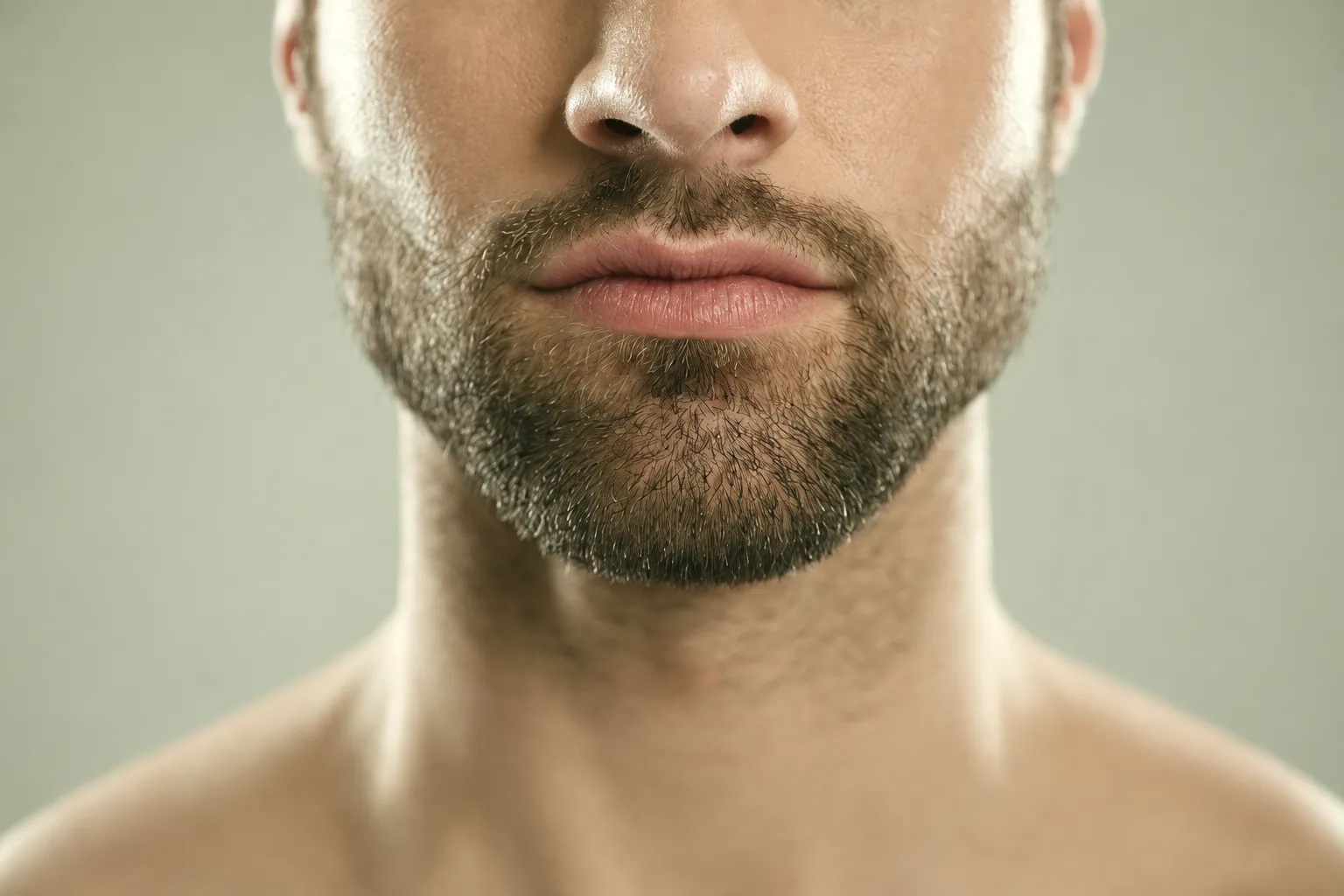

What a beard transplant actually is
A beard transplant uses the same follicular unit extraction principle as a scalp hair transplant: individual grafts are removed from a donor area (almost always the back or sides of the scalp) and implanted into the beard area to fill patchy sections, build density, or reconstruct a beard line after scarring.
Scalp hair is used because it is genetically “permanent” (resistant to the hormonal process that causes male pattern baldness) and can be harvested in large enough quantities without visibly thinning the donor zone.
Graft selection and direction mapping
Beard hair is typically coarser in caliber than scalp hair, so an experienced technician selects grafts from parts of the donor zone where the hair shaft is naturally thicker, most often the crown, to reduce the visual mismatch between transplanted and native beard hair. Direction is the other major variable: unlike scalp hair, which mostly grows in one broadly consistent direction, beard hair changes direction across small areas, downward on the chin, angled outward along the jawline, whorled around the mouth. Before any extraction happens, this direction map is charted point by point across the treatment area, since a single misangled graft is visible at close range in a way that a single misangled scalp graft usually isn’t.
Walking through a beard transplant day, step by step
It starts with the beard line itself, drawn while you can still see it. The target beard line, cheek line, and density, along with how the new growth should connect into your existing sideburns, are mapped and marked directly onto your face while you’re sitting upright, so you can check the shape before anything is numbed.
Numbing and extraction follow the same mechanics as any standard FUE session. Local anaesthetic is injected into the scalp donor area, and individual follicular units are removed one at a time with a fine punch. The one difference here is selection: the technician is deliberately favouring thicker-caliber grafts, most often from the crown, since beard hair reads as coarser than most scalp hair and a caliber mismatch is visible at close range even with good density.
While extraction continues, the direction map drives everything that happens next. Because beard hair changes direction across small areas, straight down on the chin, angled outward along the jawline, whorled around the mouth, the point-by-point direction chart made before the session started is what the recipient-site team works from, rather than a single consistent angle the way most of a scalp session would use.
Recipient sites are opened following that chart, not a uniform pattern. Each incision is angled to match the direction recorded for that exact point on the face, since a single misangled graft is far more noticeable here, viewed close-up, than an equivalent error would be on the scalp.
Placement is checked repeatedly against the original beard-line design. Grafts are placed one at a time, and the surgeon periodically compares progress against the morning’s markings to confirm the line, density, and connection to the sideburns are tracking the plan rather than drifting as the session goes on.
A full session commonly runs four to seven hours depending on graft count. Before you leave, the result is checked against the plan and you’re walked through beard-specific aftercare, including the ingrown-hair risk covered below, which differs slightly from standard scalp aftercare.
Typical cost in Istanbul
Beard transplant packages in Istanbul commonly range from €2,000 to €2,500 all-inclusive, depending on graft count. This is generally somewhat lower than a full scalp session because the treated area and graft numbers are usually smaller.
Who is a realistic candidate
Good candidates typically have:
- Patchy or uneven beard density with visible skin showing through
- Scarring from acne, injury, or previous surgery affecting beard growth
- Sufficient scalp donor density to supply both current and any possible future needs
Total beard absence due to some medical conditions may need a different evaluation. A proper individual assessment matters more than general guidelines. See our full candidacy guide for how that assessment is normally structured.
Recovery timeline
Scabbing typically resolves within 7–10 days, transplanted hairs shed by week 3–4 (expected, not a sign of failure), and regrowth becomes visible from month 3 onward. Because beard hair can be trimmed relatively short, final density is often easier to judge earlier than with a full scalp transplant, typically by month 6–9.
Limitations worth knowing
- Ingrown hairs are more common on facial skin than scalp skin during healing, generally temporary folliculitis-type bumps rather than a sign of a failed graft, but worth asking a clinic how they manage specifically.
- Caliber mismatch is a real risk if donor selection is rushed. Beard hair’s coarser texture means grafts taken without deliberate caliber-matching can look visibly finer than the native beard around them, even with correct density and angling.
- Direction errors are more visible here than on the scalp, simply because a beard is viewed close-up and head-on far more often than the top of someone’s head, which is why the point-by-point direction map matters as much as graft count.
- Donor supply is shared with any future scalp needs. A beard session draws from the same finite scalp donor pool as a hair transplant, so total lifetime graft planning should account for both if a scalp procedure is also a possibility later.