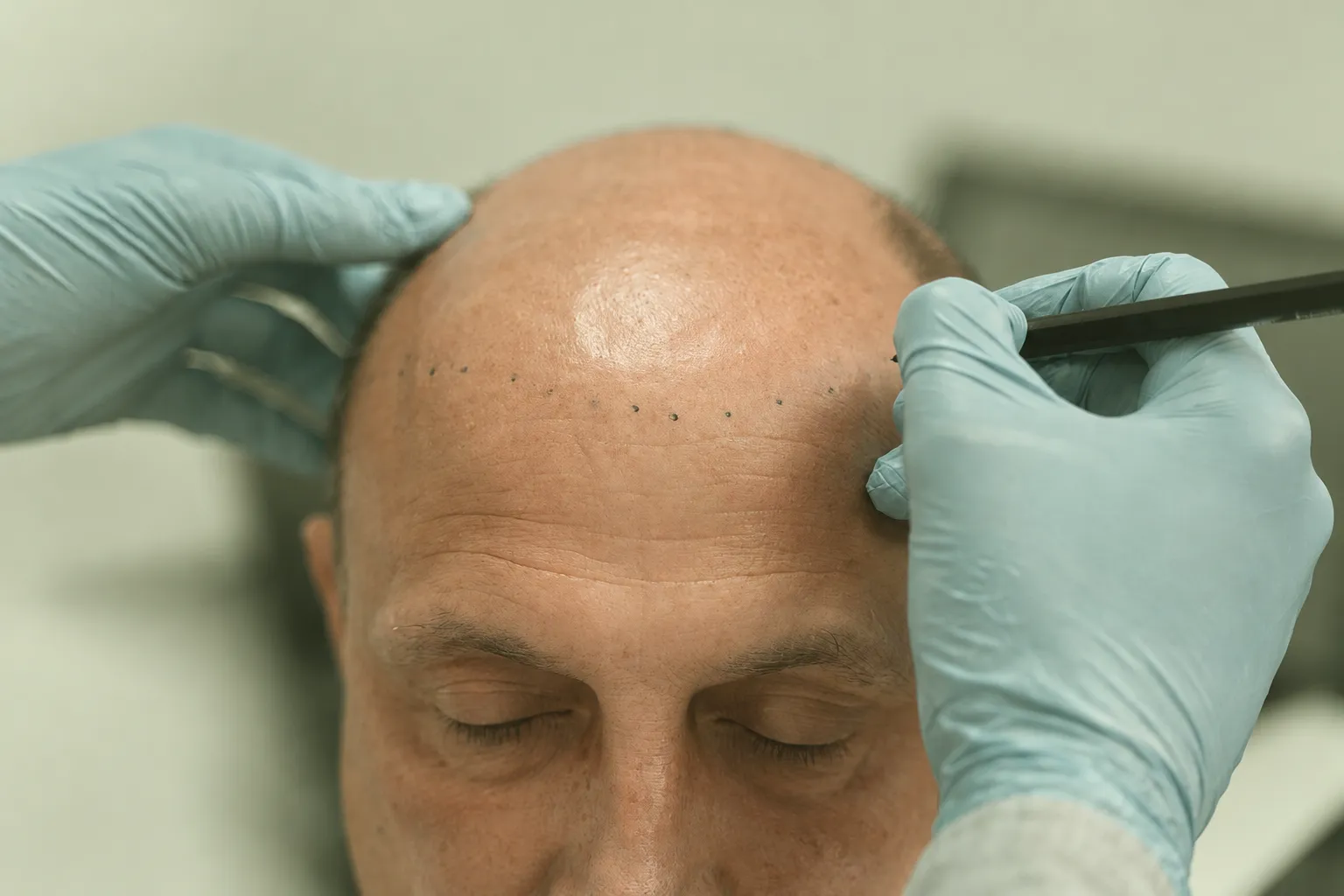

What Sapphire FUE actually is
Sapphire FUE is not a different extraction method. The follicle harvesting step, the first half of the day, is exactly the FUE process described in our main guide: same fine punch, same subsurface-angle challenge, same transection risk if the technician rushes. What changes is a single tool used later in the day, during recipient-site creation: instead of a standard surgical steel blade, the surgeon opens each site with a blade whose edge is cut from sapphire crystal, typically shaped in a shallow V or crescent profile rather than a flat slit.
Why the blade material is the whole story here
Steel blades, like any metal edge, pick up microscopic burrs and gradual dulling over the course of a long session, hundreds or thousands of individual incisions, which can make later incisions tear tissue slightly rather than cleave it cleanly. Sapphire is significantly harder than steel and holds a finer edge through far more use before it needs replacing. Manufacturers also tend to grind it into that shallow V or crescent shape rather than a straight blade, which produces an incision that narrows toward its base. Some surgeons find that shape allows a snugger fit around the graft and marginally tighter packing between adjacent sites, since less lateral tissue gets displaced per incision. That’s the entire mechanism: a sharper, more consistent edge, held for longer, cutting a slightly different-shaped opening. Nothing about the extraction, the anaesthesia, or the graft-handling protocol changes.
Is Sapphire FUE the same choice as DHI?
This is a genuinely common point of confusion, so it’s worth being direct: no, they’re not the same category of decision. “Sapphire” describes what material the recipient-site blade is made of, within the standard FUE workflow of cutting sites first and placing grafts after. “DHI” describes an entirely different implantation method, using a Choi pen to open the site and place the graft in the same motion. A surgeon could, in principle, combine sapphire-tipped tools with either workflow; the two labels are answering different questions, not competing against each other on the same list. See our FUE vs DHI comparison if you’re actually deciding between those two.
What the evidence actually supports
It is worth being direct about this too: most of the claimed benefits of sapphire blades (faster healing, less scarring, higher density) come from clinical experience and surgeon reporting rather than large, independent controlled trials directly comparing outcomes. That doesn’t mean the claims are false, since a consistently sharper edge and a narrower incision profile are a plausible mechanism for marginally better outcomes, but patients should treat “Sapphire” as a tooling refinement, not a guarantee of a different result category from well-performed standard FUE. The single biggest determinant of outcome quality remains the skill and consistency of the person making the incisions, not which material the blade is made from.
Typical cost in Istanbul
Sapphire FUE packages typically run €2,000 to €2,800 all-inclusive in Istanbul, usually a modest premium over standard steel-blade FUE for a comparable graft count.
Who it suits
Candidacy criteria are the same as for standard FUE: sufficient donor density, realistic goals, and a stable pattern of loss. See our full candidacy guide for what that assessment actually involves. The choice between steel and sapphire blades is a surgical-technique decision best made with your surgeon based on your scalp characteristics, not a factor that changes who is or isn’t a candidate.
Recovery timeline
Recovery follows the same overall biological timeline as standard FUE: shedding around weeks 2–4, dormancy through months 1–3, visible regrowth from month 3–4, and maturing results at 12–18 months. Any difference in surface healing speed between sapphire and steel blades tends to be measured in days, not months.