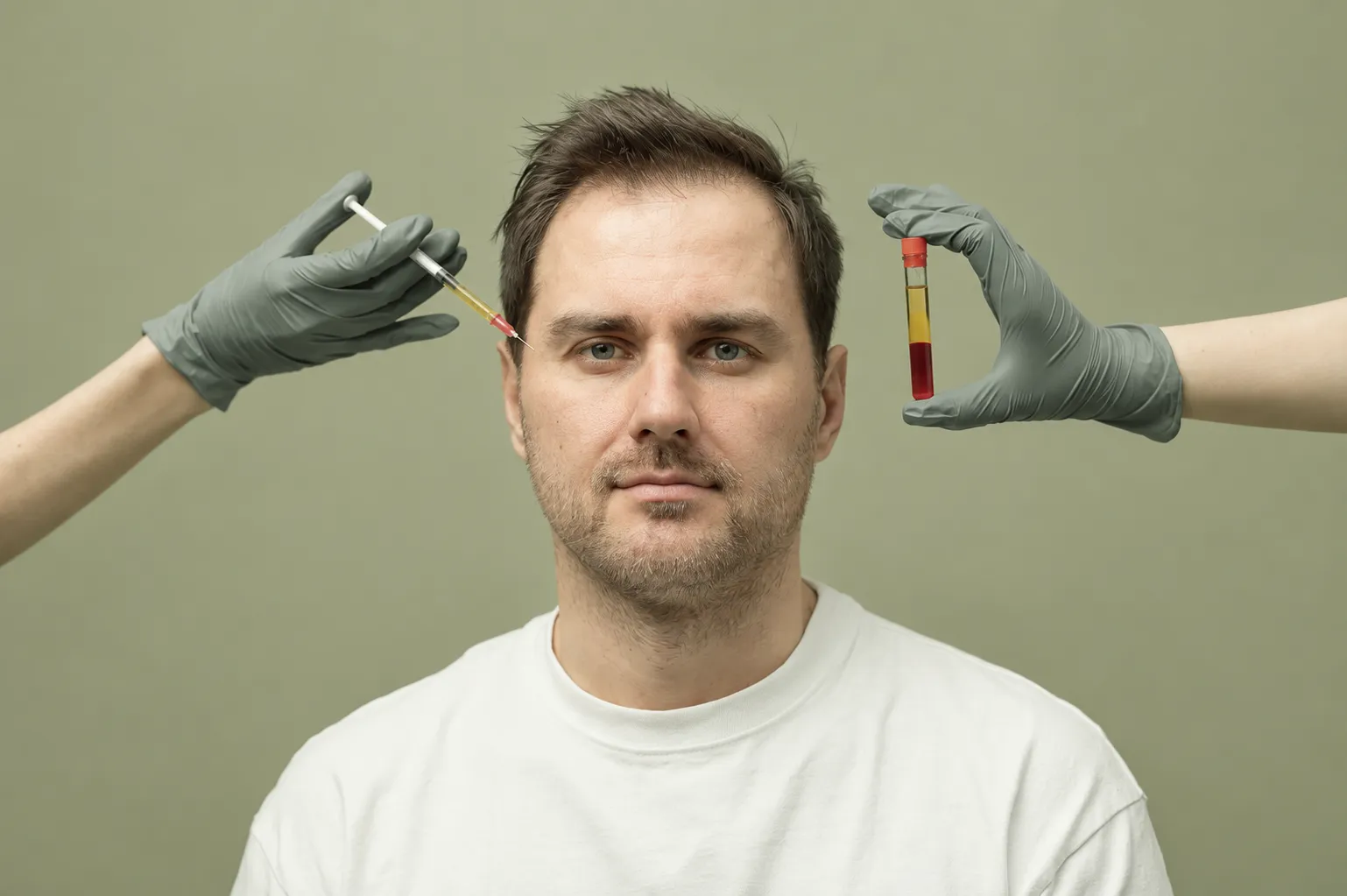

Does PRP actually work?
This is the question most people want answered before anything else, so it’s worth answering directly before getting into mechanism. For the right candidate, early-stage thinning where follicles are miniaturising but still biologically active, the evidence points to yes, PRP can meaningfully slow shedding and improve density, though not dramatically and not for everyone. It works by acting on follicles that already exist; it cannot reactivate a follicle that’s already stopped producing hair entirely. Whether it’s worth doing for a specific case depends on how early the thinning is and what the patient is actually trying to achieve, which is why this is a conversation, not a default add-on.
What PRP actually is
Platelet-Rich Plasma (PRP) therapy involves drawing a small sample of the patient’s own blood, spinning it in a centrifuge to concentrate the platelets, and injecting that concentrate into the scalp. Platelets contain growth factors, most notably platelet-derived growth factor (PDGF), vascular endothelial growth factor (VEGF), epidermal growth factor (EGF), and transforming growth factor-beta (TGF-β), thought to act on the follicle’s dermal papilla (the structure that regulates hair growth cycling) to improve local blood supply and extend the active growth phase of follicles that are still alive but miniaturising.
It’s a non-surgical treatment: no grafts are moved, and no incisions are made. It doesn’t add new follicles to the scalp; it aims to improve the function of follicles that are already there but shrinking.
Preparation protocol and why it varies between clinics
Not all PRP is prepared the same way, and the differences matter more than marketing often suggests. Centrifugation speed and duration determine the final platelet concentration, typically targeted at roughly three to five times baseline blood concentration, and also determine whether white blood cells are retained in the final preparation (leukocyte-rich PRP) or spun out (leukocyte-poor PRP), a distinction some researchers believe affects the balance between growth stimulation and inflammation. Some protocols also activate the sample with an agent such as calcium chloride before injection, intended to trigger earlier growth-factor release. None of this is standardised across the industry, which is a genuine limitation when comparing “PRP” results between different providers or different published studies, they aren’t always describing the same preparation.
Walking through a session, step by step
- Blood draw. A small sample of your own blood is taken, much like a routine blood test, usually from the arm.
- Centrifugation, while you wait. The sample is spun in a centrifuge for several minutes to separate and concentrate the platelet-rich plasma from the rest of the blood. The speed and duration of this spin is what determines the final platelet concentration and leukocyte content, so this brief waiting period is doing real clinical work, not just processing time.
- A numbing cream, if you’d like one. Some clinics apply a topical anaesthetic to the scalp beforehand, since the injections themselves are the only uncomfortable part of the appointment.
- Scalp injection. The concentrated plasma is injected into the scalp across the thinning areas, typically at a shallow subdermal depth, using a fine needle across multiple closely spaced points to distribute the growth factors evenly rather than pooling them in one spot.
- You leave the same day, no real downtime. The whole appointment, including the wait for centrifugation, usually takes well under an hour, and most patients go straight back to normal activity afterward.
What results look like, month by month
Because PRP works gradually on follicles that are still alive rather than doing anything immediate, the timeline is slower than patients often expect. In the first few weeks after a session, mild scalp tenderness or redness at injection points is normal and settles quickly; visible hair changes aren’t expected yet. Around month 3, a 3-month photo typically shows little to no dramatic difference, at most, some patients notice reduced shedding or slightly finer new growth. The more visible effect of a full course usually appears around month 4 to 6, once the second or third session in the protocol has had time to act. This is a meaningfully slower and gentler timeline than a transplant’s growth cycle, which is worth knowing before judging whether “it’s working” too early.
What the evidence actually supports
It’s worth being direct about this: PRP has moderate clinical evidence behind it for early-stage androgenetic (pattern) hair loss, not the strong evidence base of an established surgical technique. A meaningful part of the difficulty in interpreting that evidence is the protocol variation described above: trial sample sizes tend to be small, and preparation methods differ enough between studies that pooling their results into a single confident conclusion is genuinely difficult. Results depend on the concentration protocol, the number of sessions, and individual biology, and not every patient responds the same way. It is a reasonable option to slow thinning or support a transplant, but it should not be marketed or understood as a guaranteed fix, and it will not restore hair to areas with no active follicles left.
Typical cost in Istanbul
A single PRP session in Istanbul typically costs €150 to €300, with most clinics recommending a course of three to four sessions. Combined with a hair transplant, PRP is sometimes offered as part of a package rather than priced separately; ask for an itemised breakdown so you know exactly what you’re paying for.
Who it suits
PRP tends to make the most sense for:
- Early-stage thinning where follicles are miniaturising but still active
- Patients wanting to slow further loss alongside medical treatments (like minoxidil or finasteride)
- Support alongside a transplant, to help the surrounding native hair
It is not a substitute for a transplant in areas with established, stable baldness, since there are no follicles left there to stimulate.
Recovery
There is essentially no downtime. Mild redness or tenderness at injection points typically resolves within a day or two, and most patients return to normal activity immediately.