
What FUT actually is
Follicular Unit Transplantation (FUT), sometimes called the “strip method,” is an older hair restoration technique that predates FUE. A thin strip of scalp is surgically removed from the donor area (typically the back of the head), the wound is closed directly, and the strip is then divided into individual follicular unit grafts under a microscope by a team of technicians before implantation into the recipient area.
The core difference from FUE is the harvesting step: FUT removes tissue in one continuous strip rather than extracting follicles one at a time, which is why it leaves a linear scar rather than the scattered pinpoint marks associated with FUE.
Strip design and donor-area planning
Before any incision is made, the surgeon assesses scalp laxity, how much the donor scalp can be gently stretched and pinched, since this determines how wide a strip can be removed while still allowing a tension-free closure. A tighter scalp limits strip width and therefore graft yield; a looser scalp allows a wider strip. Strip dimensions are planned accordingly, commonly in the range of roughly 1 to 1.5cm wide and as long as needed to reach the target graft count, sometimes 15 to 30cm depending on how many grafts the plan calls for. The strip location is chosen within the permanent donor zone, the band of scalp genetically resistant to pattern hair loss, positioned to leave a scar that will sit below where surrounding hair naturally covers it at a normal cut length.
Walking through an FUT day, step by step
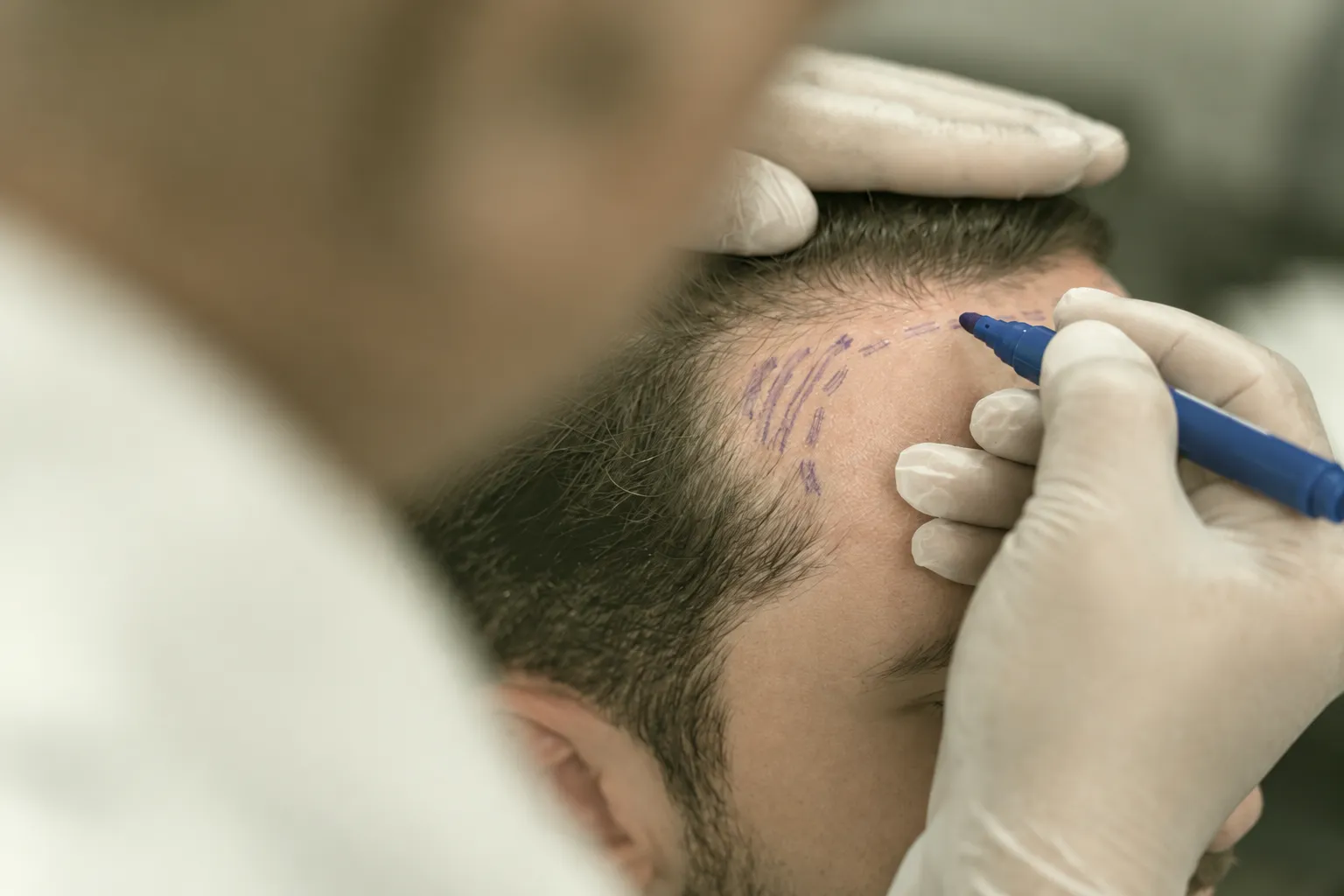
- Design and planning. As with any technique, the hairline and transplant zones are mapped first, while you’re sitting upright so you can see and approve the plan. The strip’s location and width are decided based on your scalp laxity and the graft count the plan calls for.
- Strip removal. Under local anaesthesia, a single strip of scalp tissue is surgically excised from the donor area, and the wound is closed with sutures or staples, often using a trichophytic technique that angles the wound edge so hair can eventually grow directly through the resulting scar line rather than stopping at it. You’ll feel the anaesthetic injections; the removal itself shouldn’t hurt once you’re numb.
- Graft dissection, happening in parallel with your recovery from step 2. While you rest, technicians divide the strip into individual follicular unit grafts under stereo-microscopes, examining the tissue directly to separate naturally occurring one-, two-, and three-hair units with minimal damage. This magnified, controlled dissection is a genuine technical advantage of FUT: transection rates during this step are often lower than those typical of blind punch extraction in FUE, since the technician can see exactly where each follicle sits before cutting.
- Recipient site creation. Tiny incisions are made in the balding area, angled to match natural hair growth direction, following the same density-gradient logic (finer grafts at the hairline, denser multi-hair grafts further back) used in FUE.
- Implantation. Grafts are placed into the recipient sites one by one, and by the end of the day the visible work is done, even though the strip-closure wound underneath your hair will need another week or two to fully settle.
What the donor scar actually looks like
This is, understandably, the question most people actually want answered before anything else. Immediately after surgery it’s a thin closed line, usually a few millimetres wide, running horizontally across the back of the donor area, held together with sutures or staples that come out around day 10–14. As it heals over the following months, it settles into a fine white or slightly pink line. At a normal cut length (roughly 1–2cm or longer), the surrounding hair falls over it and it isn’t visible in daily life. It becomes visible if that hair is cut very short or shaved, which is the single biggest practical trade-off to weigh against FUT’s higher single-session graft yield. A trichophytic closure, described above, can make it noticeably less obtrusive even at shorter lengths by letting fine hairs grow directly through the scar line, though it doesn’t make the scar disappear entirely.
FUT vs FUE
| FUT | FUE | |
|---|---|---|
| Donor harvesting | Single strip, closed with sutures | Individual punch extraction, no strip |
| Scarring | Linear scar, width varies | Scattered pinpoint marks |
| Grafts per session | Often higher | High, but more time-intensive per graft |
| Suture removal | Required, around day 10–14 | Not applicable |
| Short hairstyles | Scar can be visible | Generally better concealed |
Typical cost in Istanbul
FUT packages in Istanbul commonly run €1,600 to €2,800 all-inclusive, similar to or slightly below standard FUE for a comparable graft count, since strip harvesting is less time-intensive per graft than individual punch extraction. Exact pricing depends on graft count and the specific clinical plan.
Who is a realistic candidate
FUT tends to suit patients who:
- Need a very high graft count in a single session (larger Norwood stages)
- Have good scalp laxity, which affects how cleanly the donor strip closes
- Are comfortable with a linear scar and don’t plan to wear very short buzz cuts
Patients who prioritise the shortest possible hairstyles or who have limited scalp laxity are usually better assessed for FUE instead.
Recovery timeline
| Stage | Timeframe | What to expect |
|---|---|---|
| Immediate | Days 1–10 | Donor area sutures/staples in place, mild tightness |
| Suture removal | Around day 10–14 | Sutures or staples removed |
| Shedding | Weeks 2–4 | Transplanted hairs shed; this is expected, not failure |
| Dormant phase | Months 1–3 | Little visible change while follicles reset |
| Regrowth | Months 3–6 | New, finer hair begins to appear |
| Maturation | Months 9–18 | Hair thickens and takes on final texture and density |
Limitations worth knowing
The closure itself carries risks specific to strip harvesting: if closure tension is too high, the scar can widen over time (sometimes called scar stretching), and a small percentage of patients experience temporary or, less commonly, prolonged numbness behind the donor line from stretching of the sensory nerves running through that area. Repeat FUT sessions are also more constrained than repeat FUE: each subsequent strip has to be taken adjacent to the previous scar, and the scalp’s remaining laxity decreases with each harvest, which is why very large lifetime graft totals are usually planned around a combination of both techniques rather than strip harvesting alone.