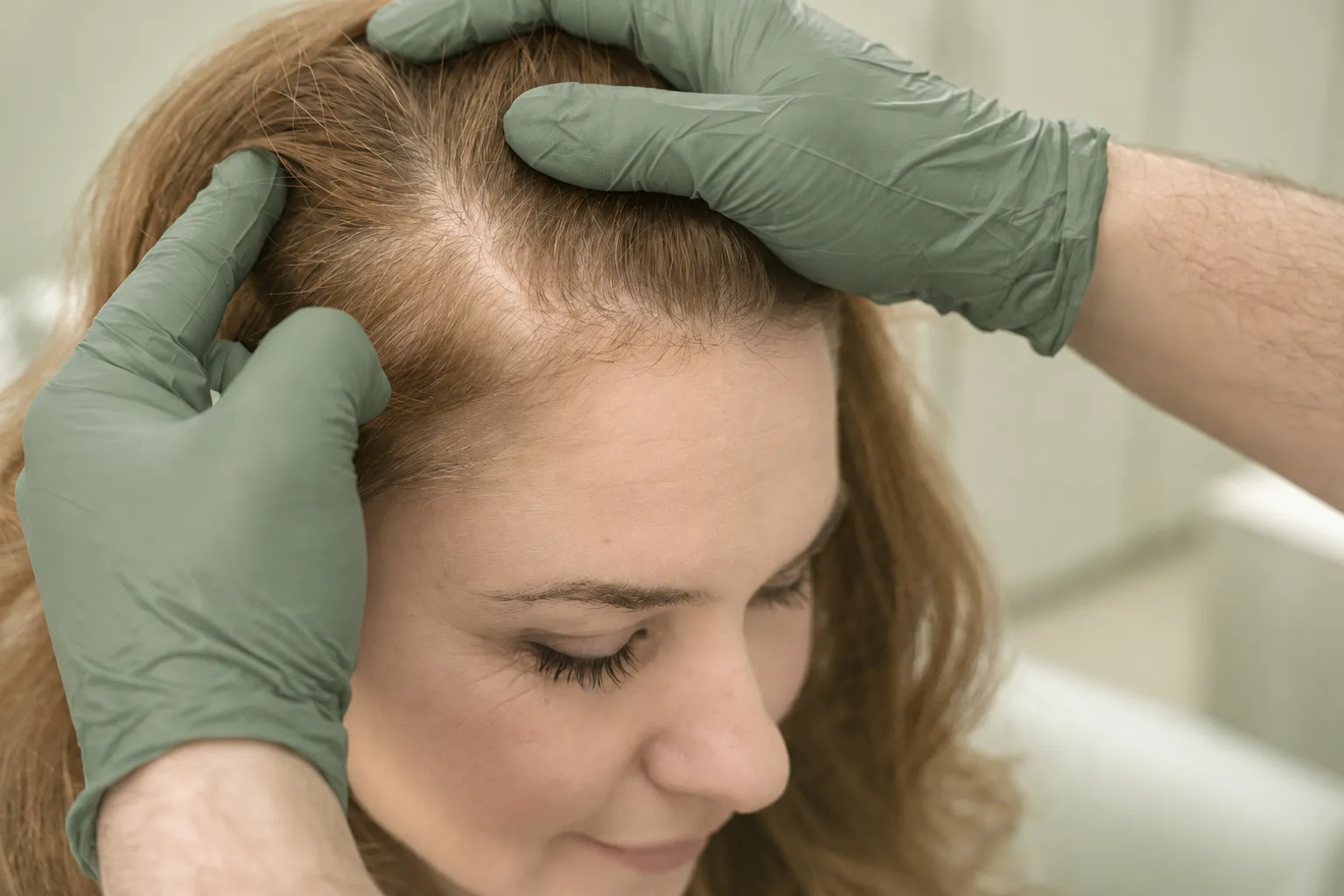

What a female hair transplant actually is
Mechanically, a female hair transplant uses the same follicular unit extraction process as a standard FUE procedure: individual grafts are removed from a donor area and implanted into thinning zones. What’s different is the pattern being treated. Male pattern hair loss usually follows the predictable Norwood progression (receding hairline, thinning crown), which makes donor and recipient areas easy to define. Female pattern hair loss is more often diffuse, general thinning spread across the scalp rather than a specific bald zone, and is more commonly classified using the Ludwig or Savin scales, which grade midline and crown thinning rather than hairline recession. This diffuse pattern makes candidacy assessment the harder part of the process.
Why diagnosis matters more here
Before any discussion of grafts or technique, a proper work-up should rule out causes of hair loss that a transplant won’t fix: telogen effluvium (stress- or illness-related shedding), hormonal imbalances, iron deficiency (checked via ferritin levels), thyroid dysfunction, or active autoimmune conditions like alopecia areata. Moving hair into an area while an underlying cause is still active can produce disappointing results, since the newly placed grafts are subject to the same process affecting the native hair. See our hair loss diagnosis guide for how this work-up is normally structured.
Why the donor area itself needs closer scrutiny
This is the detail that most distinguishes female candidacy assessment from male: in classic male pattern baldness, the occipital donor zone is reliably permanent, resistant to the process affecting the rest of the scalp. In diffuse female pattern loss, that same zone can show early, subclinical miniaturisation that isn’t obvious on a visual exam alone. This is why a genuine work-up for women more often includes trichoscopy (a magnified scan of the scalp to measure hair shaft diameter and detect early miniaturisation) or, less commonly, a small donor biopsy, to confirm the intended donor area is actually stable before any grafts are committed to it. Treating the donor zone as automatically safe, the working assumption in most male cases, is a meaningfully riskier assumption here.
Walking through a female hair transplant day, step by step
The work that matters most here happens before the day of surgery. By the time you’re in the chair, the diagnostic work-up, bloodwork, scalp examination, and often trichoscopy, should already have confirmed a stable cause and a genuinely stable donor zone. A clinic moving straight to scheduling a procedure without this step is skipping the part of the process that matters most for diffuse female pattern loss specifically.
Marking happens while you’re sitting upright, as with any session, but the hairline design conversation tends to run longer: a female hairline is typically planned rounder and softer than a male one, following the natural curve most women’s original hairline had rather than a straighter, more angular male-style line, and if a hairline-lowering goal is part of the plan, that shape gets agreed here too.
Donor-area hair is trimmed only in narrow corridors, not shaved wholesale. An unshaven or partial-shave FUE technique is standard for women, trimming tiny corridors a few millimetres wide at the exact extraction points while the surrounding hair stays at its original length and falls over them immediately, so you can leave without an obviously altered hairstyle.
Extraction and the rest of the day follow the same mechanics as standard FUE, or occasionally DHI; see our FUE vs DHI comparison for how the two differ in practice. Individual follicular units are removed from the confirmed-stable donor zone and implanted into the thinning areas following the density plan agreed earlier.
Placement across diffuse thinning works differently than filling one clear bald zone. Rather than covering a single well-defined area, grafts are often distributed to boost density gradually across a broader region, blending new grafts in among existing native hair rather than replacing an empty space outright.
Before you leave, you’re walked through both the surgical aftercare and the broader picture. Because an underlying cause may still need ongoing management (medication, monitoring bloodwork), aftercare guidance here often extends beyond the standard healing instructions into how the transplant fits alongside whatever medical treatment is already addressing the root cause.
Typical cost in Istanbul
Female hair transplant packages in Istanbul typically run €2,000 to €3,000 all-inclusive, broadly similar to standard FUE pricing, with the exact figure depending on graft count and the complexity of planning.
Who is a realistic candidate
Good candidates typically have:
- A stable, clearly defined area of thinning rather than active, ongoing diffuse shedding
- A healthy, sufficiently dense donor area at the back or sides of the scalp
- Ruled-out or managed underlying medical causes of hair loss
Patients with active diffuse shedding or an unclear diagnosis are usually better served by a dermatological work-up first; a proper consultation should address this before any transplant is booked. See our full candidacy guide for how this is assessed in more general terms.
Recovery timeline
Recovery follows the same general biological timeline as a standard FUE procedure: shedding around weeks 2–4, a dormant phase through months 1–3, visible regrowth from month 3–4, and maturing density and texture at 12–18 months.
Limitations worth knowing
- A transplant does not stop an active underlying cause. If diffuse shedding is still ongoing, newly transplanted grafts sit alongside native hair that may continue thinning, which can make an otherwise successful transplant look less impressive over time if the root cause isn’t separately managed.
- Donor stability is a judgement call, not a guarantee. Even careful trichoscopy can miss very early miniaturisation, so a donor zone assessed as stable today carries a small residual risk of thinning later, more so than in typical male-pattern cases.
- Diffuse coverage can mean a less dramatic single before-and-after contrast than a male hairline or crown case, simply because the starting point is more spread out and less visually binary; this is worth calibrating expectations against before comparing results photos across different patients.
- Temporary shock loss of surrounding native hair can occur, as with any transplant, and typically resolves within a few months.