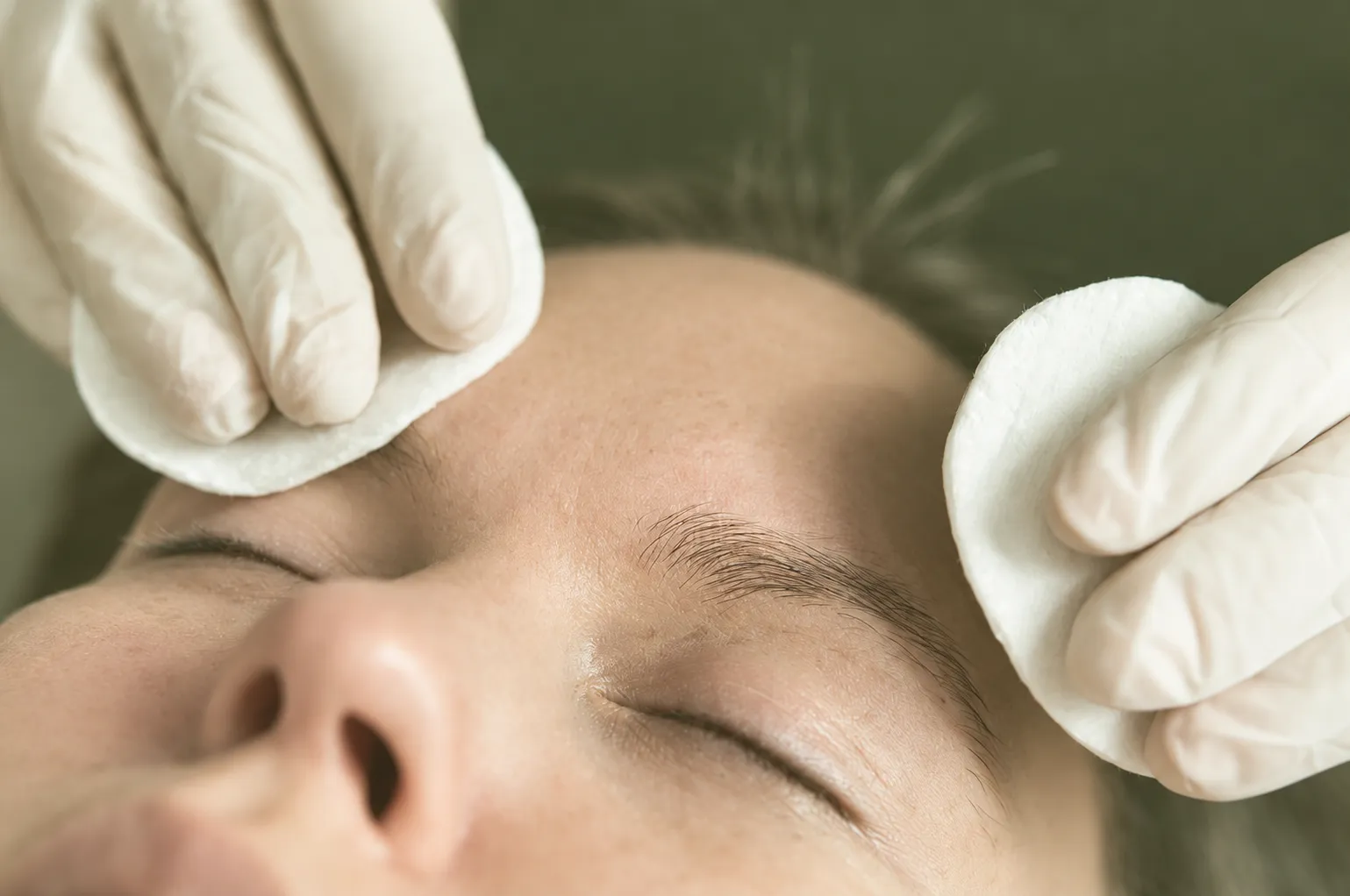

What an eyebrow transplant actually is
An eyebrow transplant uses fine, single-hair grafts, usually extracted from the nape of the scalp, where hair tends to be finer and grows at a flatter angle, to rebuild density and shape in thin, sparse, or scarred eyebrows.
Because eyebrow hairs are naturally very fine, short, and angled almost flat against the skin, this procedure demands more precision per graft than a scalp or beard transplant, even though the total graft count is much smaller.
Angle, direction, and density planning
Eyebrow hair lies almost flat against the skin, exiting at an angle of roughly 15–20 degrees rather than the steeper angle typical of scalp hair, and its direction changes across the brow: hairs near the nose point upward, hairs across the body point outward and slightly up, and hairs at the tail angle downward and back. Recipient sites are cut to match this changing direction point by point, and grafts are placed shallow enough to lie flat rather than stand up, since a graft implanted at a scalp-like angle will visibly protrude rather than blend in.
Density is also deliberately uneven, following the shape’s natural gradient: lighter at the head near the nose, densest through the body and arch, and tapered with finer grafts toward the tail, rather than filled in uniformly like a block of colour.
Walking through an eyebrow transplant day, step by step
It starts sitting up, with a mirror in your hand. Before anything is numbed, the target shape is drawn directly onto your skin with a marker, mapped against your face structure and the arch and tail you actually want, and you’re asked to look at it in a mirror and approve it while you can still see it clearly. Getting this agreement right matters more here than almost any other technical step, since eyebrow shape is judged by eye, not by graft count.
Numbing is brief, and so is the donor step. A local anaesthetic is injected at the nape of the scalp, the donor zone most commonly used because hair there tends to be finer in caliber and already grows at a flatter angle, closer to how eyebrow hair sits. Extraction itself uses the same fine hollow punch as a standard FUE procedure, but the technician is deliberately selecting for the finest-caliber single-hair units available, since coarser grafts would look out of place in a brow.
While you wait, your grafts are sorted by hand under magnification. Because almost every eyebrow graft needs to be a single hair, sorting here is more selective than for a scalp session: multi-hair units get set aside rather than used, and only clean single-hair grafts go into the holding solution for placement.
Recipient sites are opened one small section at a time, following the marked map. Each incision is cut shallow and angled to match the direction charted at that exact point on the brow, upward near the nose, outward through the body, downward and back at the tail, since a mismatch of even a few degrees is visible at normal conversation distance in a way it wouldn’t be on the scalp.
Placement is slow, deliberate work. Grafts are set in just deep enough to take, but shallow enough to lie flat against the skin rather than stand up, following the density gradient agreed at the start: lighter at the head, densest through the body and arch, tapering again at the tail. A full session commonly takes four to six hours for both brows, longer than the graft count alone would suggest, because of how much individual angle-checking this shallow, visible placement requires.
Before you leave, the shape is checked against the original plan, not just density. The surgeon compares the result to the marked design from the morning, and you’re walked through aftercare, including the maintenance expectation below, which surprises more first-time patients than almost anything else about this procedure.
Typical cost in Istanbul
Eyebrow transplant packages in Istanbul typically range from €1,500 to €2,200 all-inclusive, lower than scalp or beard procedures because of the smaller graft count, though the per-graft precision required is higher.
Who is a realistic candidate
Good candidates typically have:
- Thinning from years of over-plucking or waxing
- Sparse or patchy natural eyebrow growth
- Scarring from injury or previous surgery
- Sufficient fine donor hair, usually at the nape of the scalp
Maintenance to know before booking
This is the detail most first-time patients underestimate: because transplanted eyebrow hairs behave like scalp hair, they keep growing and require regular trimming, typically every one to two weeks, to maintain a natural eyebrow length and shape. This is a permanent, ongoing part of aftercare, not a one-time recovery step.
Recovery timeline
Scabbing resolves within about a week, transplanted hairs shed by weeks 3–4 (expected, not a sign of failure), and regrowth becomes visible from month 3 onward. Because eyebrow hair is trimmed from early on to control length, full shape and density are typically assessed around month 8–10, later than a single graft count would suggest, simply because fine single-hair grafts take a little longer to read clearly than denser multi-hair areas.
Limitations worth knowing
- Growth rate mismatch is permanent, not temporary. Because the grafts keep their scalp growth cycle, the trimming requirement described above never goes away; it’s a lifelong trade-off for restored density, not something that settles down after the first year.
- Shape is judged more subjectively than density. Two eyebrows with identical graft counts can look very different depending on arch height and tail angle, which is why the design conversation at the start matters as much as the surgeon’s technical skill during placement.
- Donor supply is limited by caliber, not just quantity. Because only the finest single-hair units are suitable, a patient with coarser overall hair texture may have a smaller usable donor pool for eyebrows than their total scalp density would suggest.
- Folliculitis can occur at either the donor or recipient sites during healing, generally mild and self-resolving, as with any FUE-based procedure.