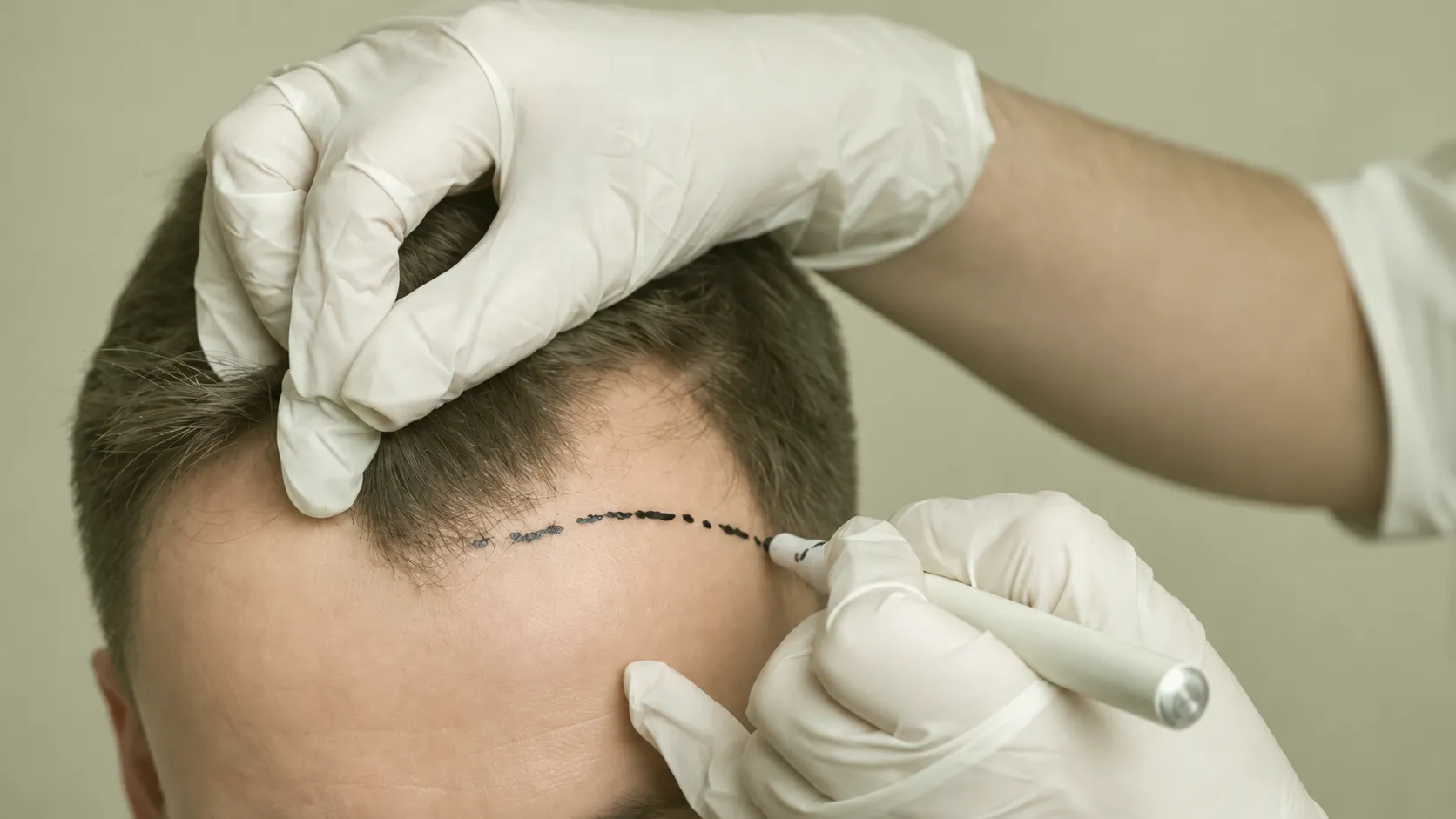

What DHI actually is
Direct Hair Implantation (DHI) is a variation of follicular unit extraction where grafts are implanted using a specialised hollow needle device, commonly called a “Choi implanter pen” after the South Korean surgeon credited with developing it. The follicle is loaded tip-first into the needle, which is then inserted directly into the scalp at a controlled angle and depth; a small plunger on the pen pushes the graft into place as the needle is withdrawn. There is no separate step of pre-making recipient incisions before placement, extraction, loading, and implantation happen in a tighter, more continuous sequence than in standard FUE.
Walking through a DHI day, step by step
The extraction half of a DHI day looks identical to an FUE day, the difference is entirely in what happens to each graft afterward. Here’s roughly how it unfolds.
Marking, numbing, and extraction happen exactly as they would for FUE. The hairline and zones are marked while you’re sitting upright, local anaesthetic is injected into the donor area, and individual follicular units are removed one at a time with a fine punch. If you’ve read our FUE guide, this first half of the day will feel familiar.
Where DHI actually diverges is what happens next. Instead of extracted grafts waiting in a holding solution until a separate incision-and-placement stage, each follicle is loaded tip-first into a Choi implanter pen, a hollow needle typically 0.6 to 1.0mm across depending on graft thickness, mounted on a pen-like handle with a small plunger. The pen is pressed into the scalp at the planned angle and depth, and the plunger pushes the graft into place as the needle is withdrawn, all in one motion. Because the same needle both opens the site and delivers the graft, the angle and depth of every single implantation is set directly by the operator’s hand at that instant, rather than by matching a graft to an incision someone else already cut. That’s the technical basis for DHI’s reputation for tighter angle control.
This precision comes with a pace trade-off. Loading a follicle into the pen by hand, one at a time, is simply slower than placing a pre-extracted graft into an already-open incision. For a large session, this is why DHI days commonly run 8–10 hours and are sometimes split across two consecutive days, to avoid grafts spending too long outside the body while waiting their turn.
Graft handling discipline matters even more here than in standard FUE. Because implantation happens later in the sequence for each individual follicle, grafts sit in a chilled holding solution for longer on average, so a well-drilled team keeps the gap between extraction and loading as tight as possible. This is one of the more meaningful, if less visible, differences between an experienced DHI team and an inexperienced one.
See our full FUE vs DHI comparison for the table breakdown and which scenarios each typically favours.
Robotic-assisted DHI
Some clinics advertise “robotic DHI,” which usually means a robotic arm, most commonly the ARTAS system, assists the extraction step by using machine vision to identify and harvest follicles with consistent precision. It’s worth being precise about what this does and doesn’t mean: the robot assists one part of the process, extraction, while implantation with the Choi pen is still done by hand. It is not a fully automated procedure, and the skill of the surgical team overseeing extraction and performing implantation still drives the outcome. Robotic assistance can help with extraction consistency over a long session, but it doesn’t replace the judgement involved in planning and placement.
Typical cost in Istanbul
DHI packages in Istanbul typically run from €2,000 to €3,000 all-inclusive, somewhat higher than standard FUE because of the additional time and instrumentation involved. As with any technique, the final price depends on graft count and the specific plan agreed after assessment.
Who tends to benefit most
DHI is often recommended for:
- Hairline design, where precise angle and density control matter most
- Patients wanting minimal shedding of native hair around the treated zone, since sites aren’t pre-cut in bulk ahead of implantation
- Smaller or moderate sessions where the extra time per graft is manageable
For very large sessions (5,000+ grafts), the time cost of DHI can be a practical limiting factor, and a hybrid FUE/DHI approach is sometimes used: FUE for broad coverage, DHI for the hairline. See our candidacy guide for how a plan decides between them.
Recovery, month by month
Recovery follows a similar biological timeline to FUE, since the same trauma-and-regrowth cycle governs any transplanted follicle regardless of which tool placed it. Broken down by what you’d actually notice:
- Week 1: scabbing at each implantation point, mild swelling possible; some DHI patients report slightly less visible scabbing than FUE in this window, since no separate incision step is used, though this varies by individual.
- Weeks 2–4: the transplanted hair shaft sheds. This is expected, not a sign the graft failed; the follicle underneath is still alive and has simply been pushed into a resting (telogen) phase by the trauma of implantation.
- After 1 month: the scalp typically looks close to normal, but this is the “nothing is happening” phase, follicles are dormant, not yet regrowing, which is often the hardest stretch psychologically.
- Months 3–4: follicles re-enter an active growth (anagen) phase and new, finer hair starts to appear.
- Months 6–12: hair thickens and takes on more of its final texture.
- Months 12–18: final density and result, the point at which before-and-after comparisons are actually meaningful.
See our recovery and results guide for what’s normal versus what needs a doctor’s attention at each stage.
Limitations worth knowing
DHI shares the same fundamental constraints as any follicular unit technique: donor supply is finite, transection can still occur during extraction, and graft survival depends heavily on handling time and technician skill rather than the tool itself. The pen mechanism reduces certain sources of angle mismatch but does not eliminate the underlying biology, an implanted follicle still has to survive the same trauma, dormancy, and regrowth cycle regardless of which device placed it.