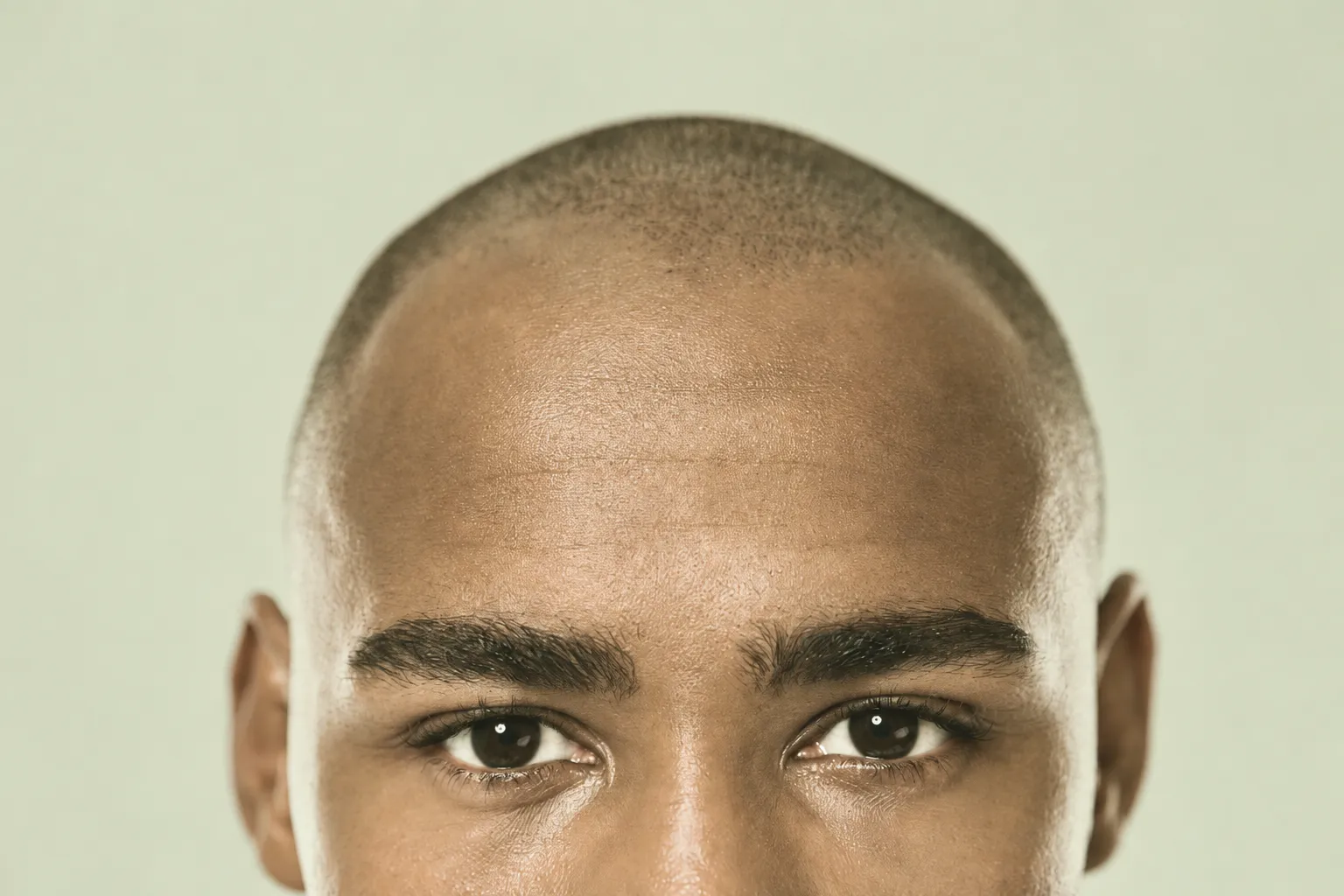

What’s different about afro-textured hair transplant
The core FUE mechanics (extraction, then implantation) are the same regardless of hair type. What changes is the difficulty of the extraction step. Straight hair follicles generally run in a fairly predictable, straight line beneath the skin, which makes them easier to extract cleanly with a standard punch tool. Curly and coily follicles frequently curve, sometimes sharply, below the surface, so a punch that looks correctly aligned from above can still miss or damage (transect) the follicle underneath.
Walking through an afro-textured FUE day, step by step
Marking and numbing happen as they would for any FUE session. The hairline and treatment zones are agreed and marked while you’re sitting upright, and local anaesthetic is injected into the donor area before anything else begins.
Extraction is where this session diverges, and it starts with the tools themselves. A surgeon experienced with curly hair often switches to a hybrid sharp-flat punch, a sharp outer edge paired with a blunter internal cannula, sometimes sized slightly larger than for straight hair, specifically to track a curved follicle’s path with less shearing force than a fully sharp, narrow punch would apply. Extraction proceeds more slowly than on straight hair, since the person extracting has to feel out each follicle’s individual curve beneath the skin rather than assume a straight path, and rushing this step on curly hair raises the transection rate more sharply than it would on straighter hair.
Grafts are sorted and held exactly as in standard FUE, chilled and ready for placement, but the slower extraction pace upstream means the overall day runs longer, commonly seven to nine hours rather than the six to eight typical of a straight-hair session of comparable graft count.
Recipient sites are opened following the same density-and-direction logic as any FUE procedure, described in more detail in our main FUE walkthrough, with finer single-hair grafts at the hairline and denser units further back.
Placement requires extra care to preserve the natural coil. A curved graft has to be set into the recipient site in a way that lets it continue curling as it grows, rather than forcing it to sit unnaturally straight, so the person placing grafts is watching coil orientation as well as angle and depth.
Before you leave, the surgeon reviews coverage against the plan, as with any FUE session, and you’re walked through aftercare. See our full step-by-step procedure walkthrough for how these same general stages apply across techniques.
A related, separate consideration for some patients is a higher individual tendency toward keloid or hypertrophic scarring, which is a skin-healing characteristic rather than something specific to curly hair itself, but is worth flagging during consultation since it can affect how conservatively a surgeon plans the donor extraction pattern.
Typical cost in Istanbul
Afro-textured hair transplant packages in Istanbul typically run €2,000 to €3,000 all-inclusive, somewhat higher than standard FUE, reflecting the additional time and skill the extraction step requires.
Who is a realistic candidate
Good candidates typically have:
- Tightly curled or coily hair with sufficient donor density
- Realistic expectations about session length, since extraction is slower than with straight hair
- A surgical team with a specific, demonstrable track record on curly and coily hair, not just hair transplants in general
Choosing a team without documented experience on afro-textured hair carries a real risk of higher transection rates and lower graft survival; this is worth asking about directly during consultation. See our full candidacy guide for how a broader assessment is normally structured.
Recovery timeline
Recovery follows the same overall biological timeline as standard FUE: shedding around weeks 2–4, a dormant phase through months 1–3, visible regrowth from month 3–4, and maturing density and texture at 12–18 months.
Limitations worth knowing
- Transection risk is higher without the right team, not because of the hair itself but because extracting a curved follicle blind, through skin, is a harder technical task than extracting a straight one. This makes surgeon-specific experience a bigger factor in outcome quality than for straight-hair FUE.
- Session length runs longer, which can mean a higher per-session cost or, in some plans, a session split across more than one day for very large graft counts.
- Keloid or hypertrophic scarring tendency, where present, is a separate, individual skin characteristic worth disclosing during consultation, since it can change how the donor area is planned regardless of hair texture.
- FUT remains a legitimate alternative for some cases, since microscopic strip dissection avoids the blind-extraction problem entirely at the cost of a linear scar; it’s worth discussing both options rather than assuming FUE is automatically the right call.