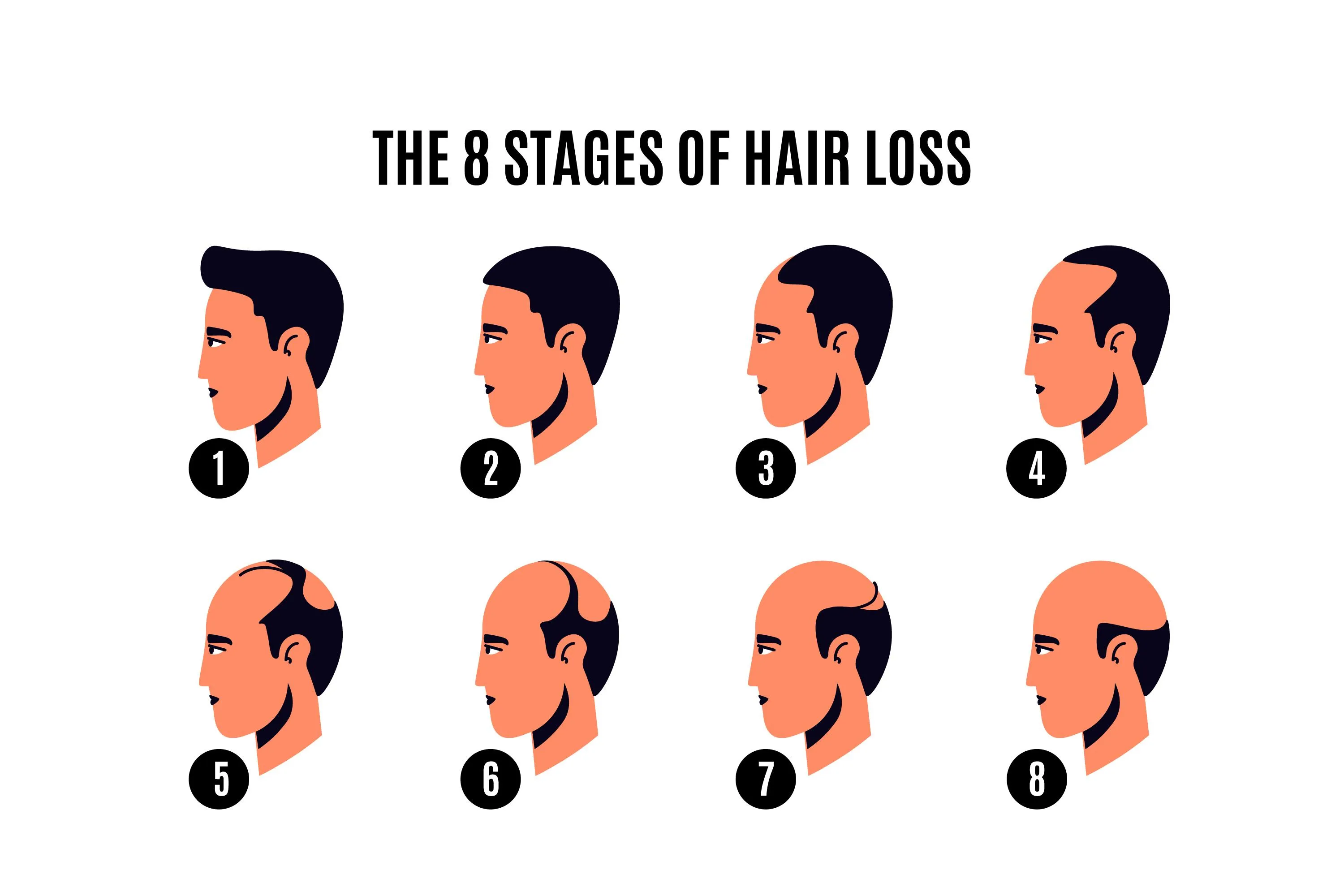

Almost every hair transplant conversation (cost estimates, graft counts, candidacy) references the “Norwood stage” of your hair loss. It’s worth understanding what that actually means before you get quotes, because it directly shapes what’s realistic.
What the Norwood scale is
The Norwood-Hamilton scale is the standard classification system for male pattern hair loss, running from stage 1 (no significant loss) to stage 7 (extensive loss with only a horseshoe-shaped band of hair remaining at the back and sides).
The stages, briefly
- Stage 1: No clinically significant hair loss or recession.
- Stage 2: Slight recession around the temples (“mature hairline”), often not considered true balding.
- Stage 3: The first stage generally considered clinically significant balding; deep temple recession, sometimes with thinning at the crown (Stage 3 Vertex).
- Stage 4: More pronounced recession with a distinct, sparser bridge of hair separating the front from a thinning crown.
- Stage 5: The bridge between front and crown balding narrows further; the two areas are still separated but the gap is smaller.
- Stage 6: The bridge disappears; front and crown balding merge into one continuous area.
- Stage 7: The most advanced stage; only a narrow band of hair remains around the sides and back of the head.
Why this matters for transplant planning
Two things depend heavily on your stage:
-
Realistic graft count. Later stages need more grafts to cover a larger area, but critically, later stages also often mean the donor area (back/sides) has less total hair to work with proportionally: it needs to cover more ground. See our cost guide for how graft count actually drives price.
-
Whether one session is enough. Stage 2–4 is often achievable in a single well-planned session. Stage 5–7 sometimes requires two sessions, spaced months apart, or a deliberate decision to prioritise certain zones (typically the frontal third and hairline) over total coverage, since donor supply is finite. This is exactly what surgical planning is for.
The most common planning mistake
The most common mistake isn’t choosing the wrong technique. It’s underestimating that hair loss is often progressive. A transplant restores existing follicles to a new location; it doesn’t stop the underlying miniaturisation process affecting your remaining native hair. This is why a proper consultation should discuss your stage and your family history/trajectory, not just your current photo: a hairline designed only around today’s pattern can look disconnected from a hairline that continues to recede for another 5–10 years. Our hair loss diagnosis guide covers this in more depth.
This is a genuinely individual assessment. If you’re unsure of your own stage, a photo-based or in-person consultation with a qualified professional is far more reliable than self-diagnosing from a chart. Once you have a sense of your stage, our candidacy guide covers what else actually determines whether a transplant is a good fit.